
OKRs Done Right: From Adoption to Strategic Operating System
Many businesses are using OKR tools. Only a few see real, organisation-wide impact.
At Change Stack Advisory, we specialise in closing the execution gap - turning OKRs from a pilot or software feature into your strategic operating rhythm.
Why OKRs?
Most strategies fail not because leaders lack ambition, but because execution falls short.
Teams don’t always understand how their work connects to the bigger picture.
Priorities shift and momentum fades.
Success gets measured in outputs, not outcomes.
Objectives & Key Results (OKRs) fix this. They create a simple rhythm where leaders set clear objectives, teams align their work, and progress is tracked transparently.
From Roadmap to Rhythm:
After your 30-day Success Roadmap, the next step is to turn priorities into action.
We help you embed OKRs as the delivery engine for your roadmap:
• Leadership-level OKRs to anchor strategy.
• Team-level OKRs to drive execution.
• Quarterly alignment and review cycles.
• Transparency so everyone knows what’s working (and what’s not).
The result? Your roadmap doesn’t sit on a shelf — it becomes a living, breathing system of execution.
Our implementation journey:
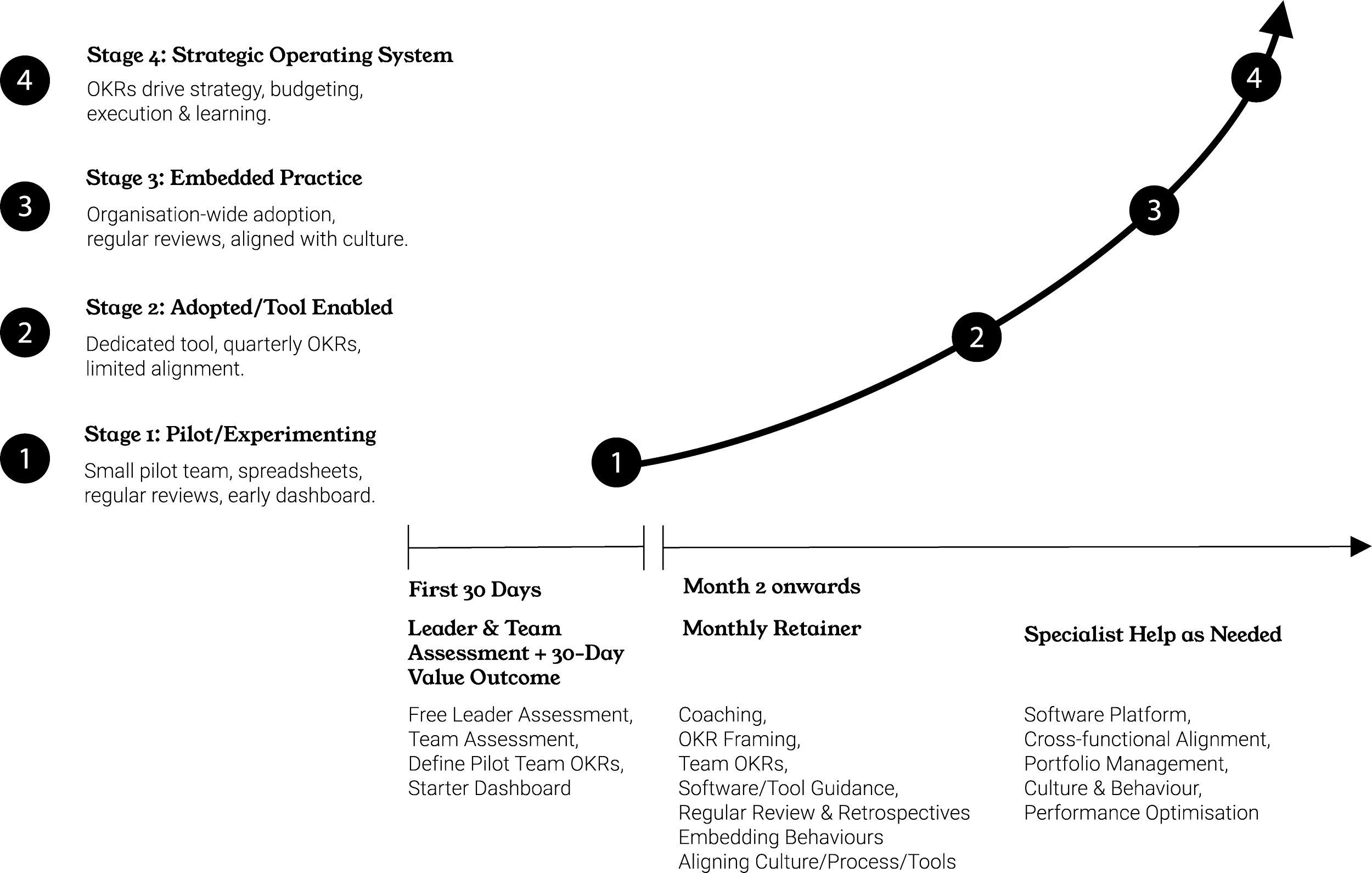
Every organisation sits somewhere on the journey from “just starting out” to “fully embedded.”
We use the OKR Maturity Curve to guide your progress step by step:
How We Help:
Quarterly OKR Workshops — set, align, and review OKRs.
Leadership Coaching — role-modelling OKR use and leading by example.
Team Facilitation — support to make OKRs meaningful, not mechanical.
Technology Guidance — selecting and embedding tools (e.g. Mooncamp) to track OKRs.
Health Checks — regular reviews against the OKR Maturity Curve.
Why It Works:
Clarity — everyone knows the priorities.
Alignment — teams see how their work connects to company objectives.
Focus — leaders stop chasing everything at once.
Momentum — progress reviewed every quarter, not every year.
Capability — OKRs build organisational muscle, not dependency on consultants.
OKR FAQs:
Do we need dedicated OKR software from the start?
Not necessarily. Most organisations benefit from starting simple — even with spreadsheets. Software helps once the basics are in place, but early focus should be on building the rhythm and behaviours.
How many OKRs is too many?
If everything is important, nothing is. We recommend no more than 3 objectives per team, each with 3 measurable key results. Too many OKRs dilute focus and make tracking unmanageable.
How long before we see value?
With the right support, you should see clarity and alignment within the first 30 days. Measurable impact usually shows within a quarter, especially if reviews and retros are embedded from the start.
What if teams resist OKRs?
Resistance is normal if OKRs are seen as “extra work” or “top-down targets.” The key is to involve teams in writing their OKRs, show how they connect to strategy, and treat them as a learning tool, not a performance stick.
What’s the difference between OKRs and KPIs?
We maintain that KPIs measure business-as-usual performance, and OKRs define what you want to change or improve. KPIs keep the lights on; OKRs push the business forward. Both are useful, but they serve different purposes.